Search This Blog

Showing posts with label exploration. Show all posts

Sunday, February 19, 2023

LIBE 467 Reflections for Theme 2


A library is a place of safety, a haven from the world. 
It’s a place with librarians in it.
We need to teach our children to read and enjoy reading.
We need libraries. 
We need books. 
We need literate citizens.

Neil Gaiman, 2013

"The reference interview is fundamentally a conversation between the school library media specialist and the study, for the purpose of clarifying the students' needs and aiding in meeting those needs" 
(Riedling, 2013, p.99)


I work 4 days a week in a K-5 LC.  75% of my time is prep time.  The other 25% is my prep time, collaboration, and library administration time.  From what I hear around the district, I feel more privileged than most to receive library administration time.  I also feel very supported with having an experienced library technician 50% of my time. Besides recess, lunch, before, and after school there is very little time built into the day's schedule to provide a calm, quiet environment to give my full focus on a question that may arise from students or staff.  I see 16 of the 22 divisions on my 4 days and to be honest, I need my breaks to decompress.  However, I am very mindful of my role to provide the most accurate and relevant information to users of the LC. 

We need literate citizens. People learn best when they feel safe and cared for, in an environment that nurtures trust and openness.


   Photograph was taken in Langley, BC February 2023
I am working hard to learn more about the 550+ students and staff I work with.  I carry post-its everywhere.  There are so many of them and just one of me.  I write down each question/query so that if I am unable to answer that question at the moment, they know (and I know) I will get to it as soon as I can, which curiously enough, is before or after school, recess, and lunch breaks.  To help with this, I ask students to tell me what's on their minds or what they are curious about (related or unrelated to the LC) at the beginning of their prep during attendance.  I also write a quick reflection about the prep session I had with the class so I can refer it to the next time I see them.  This gives me more of a handle on where I should direct some of my information-giving before sending them off to browse the collection and planning ahead with their LC-related skills activities.

Created on Canva 
 

Photograph was taken in Langley, B.C., February 2023
Three basic purposes of reference interview questioning are as follows:

1) to ascertain what information the student wants
2) to clarify the question (what it really means)
3) to discover the amount, level, and difficulty of the resources that will answer the question

(Riedling, 2013, p. 103)


I find I am able to satisfy the purposes outlined above with adequate efficiency in relation to ready references.  I have focused on familiarizing myself with the collection in our LC regularly.  Because our collection only builds with the acquisition and purchasing by me, I can easily direct students and staff to materials we have, or if we don't have, I am able to navigate our district catalog with ease.  Recently, the Grade two teachers were planning a Book Tasting and I was able to gather various genres of books at their grade level for them quickly.

Research project interviews, as Riedling describes them, "...lie at the other end of the spectrum" (2013, p.104).  I am confident I can steer the student to a resource they can access and any following resources that may be needed.  However, being able to provide prompt, regular interactions or teacher literacy skills for a single student is highly improbable.  This provides a great opportunity to offer my collaboration time and services to the classrooms to be active participants in their learning for their research.

BCTLA.ca
The biggest takeaway from reviewing BCTLA Working and Learning Conditions was the unbalanced access to materials in the province.  I was surprised to see that the Richmond District's responding schools allotted an average of nearly $20 per student whereas Maple Ridge was only $3 per student.  To see that the average funding for elementary schools a few years ago was just under $3 000 made me hope that schools were receiving funding from PAC, gathering funds from Scholastic Book Fairs, and/or grants.  If we use Riedling's definition of reference resources as "sources specifically designed to be consulted for definite items of information" (2013, 139), the cost of dictionaries, encyclopedias, and atlases seems quite high.  Because we are building a collection to meet our users' needs and needs vary from school to school, a committee of financial stakeholders like the principal, district principal if you can, PAC members, as well as student and staff representatives, would be beneficial to outline what is needed for the LC, both in physical and digital formats.  From thereon, acquiring wishlisted resources and calculating costs would perhaps help persuade PAC and the district to provide more monetary support.  I have already been told many times that PAC will not be supporting the LC for the next few years as they are putting all their fundraising toward playground equipment.

As I have mentioned in my previous blog, a space encyclopedia is the extent of our K-5 physical resource reference collection.  Encyclopedias are limited to more topic-related rather than something vaster like Britannica.  After more probing on the district elementary's catalog, almanacs have more recent publishing dates and National Geographic dominates many of the elementary schools' collections.  I use the term "dominating" loosely as there are only one or two copies of resource reference titles within the entire district of elementary schools.

bitmoji.com


  1. "School districts’ funding is established at the provincial level... Note that the provincial allocation to districts does not specifically target funding for learning resources" (ERAC, 2008, p. 70)

SD35 provides across-the-district resources like the digital resources found on their website as well as resources from the district learning commons.  Oftentimes there is something new like Mystery Science available for the year, but each school would have to purchase or ask the district for funds to continue a digital resource if teachers asked for it.  This doesn't always mean schools receive it.

"The main goal in acquiring learning resources is to make them available as quickly, efficiently, and cost-effectively as possible. The purchasing process is enhanced by ordering from as few sources as possible; for example from consortia, wholesalers or jobbers, bulk ordering of key resources, etc." ((ERAC, 2008, p. 76).  I see this as part of my role as a TL to promote the materials we have available to us as educators through staff meetings, e-mails, and collaboration.

"In carrying out these evaluations, it is recommended that teachers consider all five areas of the Ministry evaluation criteria: curriculum fit, content, instructional design, technical design, and social considerations" (ERAC, 2008, p.75).  A few years ago, teachers were able to use their own Apple ID and add apps to their class iPads without consulting evaluative-type permissions from the administrator.  Now, apps can only be downloaded through a self-service which has been vetted by the district IT department. 

Money is tight and educators need to be proactive.  I fully support open access to resources.  If educators can back up the rationale behind using them using a school or district selection criteria and the administrator is aware of the use, then this would save the classroom and school money and the resource can easily be shared amongst colleagues.  When evaluating and then selecting such resources some points to keep in mind are:

  • differentiation to fit student levels and age-appropriateness
  • copyright issues
  • tech issues (as it is already difficult to get IT to problem-solve vetted resources from the district)
  • quality as we want to give the best resources to our learners

Hillary Clinton, ALA 2013

Nothing compares to a live human being in your learning environment whose primary job is to boost your learning.  Paralleling the LC as the "hub" of the school community, Clinton states: "We need libraries more than ever because they are places for communities to come together... as librarians you go above and beyond every single day to serve the needs of the people living in your communities."


Photograph taken in Langley, B.C. 2023


Photograph taken in Langley, B.C. 2023


There is no one way to deliver a library program to your users because there is no identical type of users in each school, and there is no identical school.  There are many guidelines offered by each district and by the provincial TL associations, and the ministry itself.   We have established how time and money bear a strain on providing access to the best resources for our learners so that they can meet their full potential.  With the changing times of DIY videos, self check-outs in grocey stores, AI programs that claim to substitute health professionals and educators,  I am not the one to devalue my profession and myself as a professional.  The photographs above did not create a safe, inviting space that promotes learning and reading in the LC; a living, breathing person with passions and hopes to motivate her community did.  Each LC curated resources and space both physically and virtually to meet the needs of their users.


References


BCTLA. (n.d.). BC teacher-librarians' association. Evaluating, Selecting and Acquiring Learning Resources: A Guide. Retrieved from https://bctla.ca/wp-content/uploads/2018/02/erac_wb.pdf 


Bctladotca.files.wordpress.com. (n.d.). Retrieved from https://bctladotca.files.wordpress.com/2019/05/bctla-presentation.pptx 


CNN. (2017). Hillary Clinton full Ala Conference speech. YouTube. Retrieved February 15, 2023, from https://youtu.be/S8OEAPSFp4c


Gaiman, N. (2013) Neil Gaiman: Why Our Future Depends on Libraries, Reading and Daydreaming. The Guardian. 

http://www.theguardian.com/books/2013/oct/15/neil-gaiman-future-libraries-reading-daydreaming


Perkins, M. (2013). Canva: free design tool. Canva. Retrieved February 16, 2023, from https://www.canva.com/ 


Riedling, A. M., & Houston, C. (2013). Reference skills for the school librarian: Tools and tips. Libraries Unlimited, an imprint of ABC CLIO, LLC. 

Tuesday, December 1, 2020

LIBE 477 Digital Artifact - Diamond in the Rough


Image from Bitmoji.com


My BluePrint: “About Me” Lesson Ideas


A Magical Carpet Ride

I set out on this journey believing the following:
  • Children are unique with many individual strengths and must have a learning environment that supports their physical, mental, emotional, and social growth.
  • As an educator, I intend to create a safe, inclusive, calm, and positive environment where students feel encouraged to pursue their personal interests and take risks.
  • I hope students embrace their mistakes and feel pride for their many accomplishments.
Now, replace children and students with myself as a learner.  In short, I began this inquiry project with little confidence in my abilities as a 21st century learner.  My childhood communication tool to the outside world was a rotary dial phone.
Image from artfire.com

I felt too self-conscious to reach out for support from colleagues and was overwhelmed with help tutorials and video instructions on the internet.

I learned to change my growth mindset and develop a personal learning network.  Carol Dweck, author of Mindset, The New Psychology of Success, urges us to praise the process and the resilience, YET, not the end product and natural talent, the NOW.


Image from bitmoji.com

In the article “Building a Growth Mindset for Teachers”, Jennifer Gunn outlines some sound advice that reflects my own key learnings from the course:
☝ Never Stop Growing.
✌ Experiment and Innovate.
👍 Ask Questions.
👌 Be Flexible.
✊ Reflect. Reflect. Reflect.
👏 Learn New Technology.


Bippity, boppity, boo! I did, I am, I will continue to.  

My Blueprint is an online, visual student driven portfolio.  I created a virtual classroom where students could practice self-awareness skills and explore their interests, abilities, and passions.  They were able to use multimodal ways (video, audio, pictures) to document their growth.  Other teachers in the school and families can also connect and have the same access as the teacher - post, comment, offer feedback, add stickers.  It is most definitely a work in progress; the students' portfolio are emerging. By term 2, I would like to see us at developing, then proficient by June 2021.  Here are a few samples (click to enlarge):

Image from student portfolio; Myblueprint.ca, 2020

Image from student portfolio; Myblueprint.ca, 2020

Y
Image from student portfolio; Myblueprint.ca, 2020

Image from student portfolio; Myblueprint.ca, 2020


As I look back on my first blog posts, I wanted to delve deeper into one digital tool that focused on growth of the individual learner.  We were bombarded with new technology during remote learning, so I isolated My Blueprint and the About Me section. As Ron Weasley once said, “What’s life without a few dragons?” (J.K. Rowling, 2000)

1. TIME - We only had full sets of iPads alternate weeks and finding a large chunk of time, without interruptions to explore, was a rare treasure. 

2. ABILITY - Some students were able to navigate the program with ease.  Others spent most of their time just logging in.  Thankfully we have been talking about "The Power of Yet" and students were praised on perseverance rather than completed work.  No tears.

3. DEVICE SETTINGS - Some students didn't have their camera/video working.  Others would crash because there were too many photos taking up space.  Then there was the spinning wheel of impending crash and burn.  We shrugged, tried other devices, e-mailed IT, again, thankfully, no tears.

4. COMPREHENSION - There was A LOT of background knowledge that needed to be taught and prepared; some that were understandable like explaining the abstract, symbolic concept of personal values and attributes.  Then there were others like, "You don't know where your family is originally from? No, not Coquitlam, before that.  No.  Not Alberta, your great grandparents?"

5. COLLABORATION - In the past, I relied a lot on students supporting each other, but with COVID-19 restrictions, masks/no masks, and just for health & safety reasons, students were left waiting for support.


“There is still much worth in having a shared experience, a common narrative for learning.”
- Richardson, 2012

Moving Forward. . .

After I get valuable feedback from members of LIBE 477, I would like to do some touch-ups, download the Pages artifact into my school's Teams channels,
Image from tech community.microsoft.com 

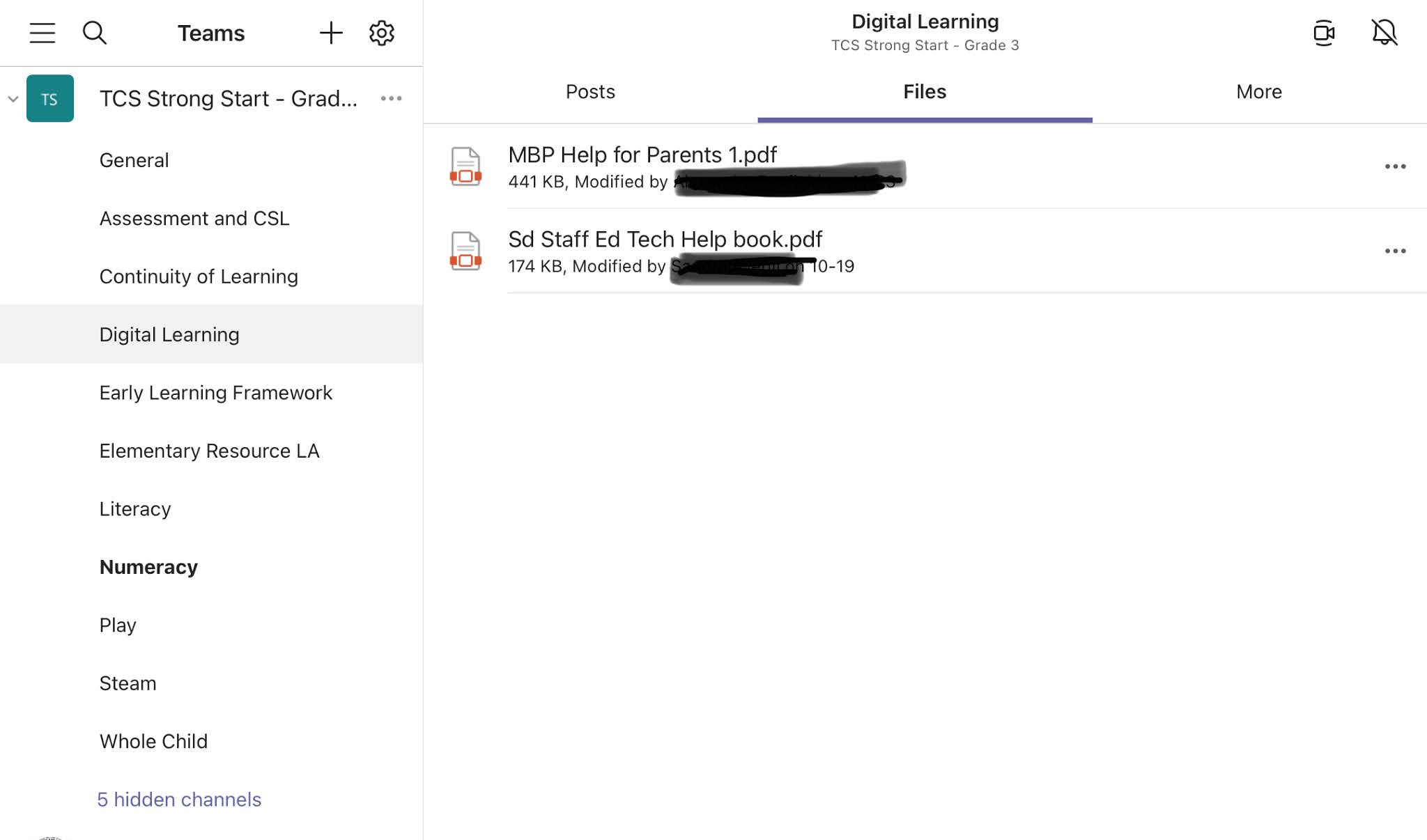
and discuss it during future grade group collaboration time with other primary teachers, our MBP leads at the school, and administration. I then would like to have a virtual meeting with the district's leads for more feedback, then upload the document to the district's Teams Channels under Digital Learning (gulp!).  It’s looking pretty empty...

image from Teams, 2020

I’m feeling inspired by the creative innovators of this course and encouraged to know that their ideas for fostering literacy, building critical thinking skills using hybrid models, and vetted apps and digital programs are out there in the “technagical” venture.


Image from Bitmoji.com
                           

Works Cited

Deak, J. (2016, August 23). Your Fantastic Elastic Brain READ ALOUD! ~ Stem for Kids

DoubleThink Inc. (2020). MyBlueprint.ca. Retrieved December 01, 2020, from https://myblueprint.ca/

Gunn, J. (2019, October 25). How to Build a Growth Mindset for Teachers: Resilient Educator. Retrieved December 01, 2020, from https://resilienteducator.com/classroom-resources/growth-mindset-for-teachers/

Kid Time StoryTime (Producer). (2016, August 23). Your Fantastic Elastic Brain READ ALOUD! ~ Stem for Kids [Video file]. Retrieved December 1, 2020, from https://youtu.be/8QSPfnQCIY0

Richardson, Will (2012). Why School? How Education Must Change When Learning and Information are Everywhere [eBook edition]. Ted Conferences.


Saturday, November 14, 2020

LIBE 477 Module 10: Vision of the Future EYES on the world, FEET on the ground

Eyes on the World, Feet on the Ground

Earlier in the year, I decided it was time to have my philosophy, mission, vision statements, and core values set out in writing.  With continuous professional development and learning, these principles will be fluid and change over time.


At present, I do see a classroom of engaged and inclusive learners, and I am continuing to work out on how to create a more collaborative environment that is viable during Covid times.  Learning progress is moving much slower due to less physical collaboration (small group/pair work).  Students just aren't "getting it" when they are having to trouble shoot alone.

 What will the 21st Century Classroom look like?


The 21st century classroom I envision will always involve ways to facilitate critical thinking, collaboration, communication, and creativity.


I have been very fortunate to be in a school where students have the ability to have a device available to them.  We have loaner iPad carts and COWS.  I have collaborated with my cohort teacher to have a class set of iPads every other week, while still having a half set available to me all the time.  As the students have their own One Drive account, they are able to save and access any pertinent work throughout their school career in the district.  In our SLLC, we have many loose parts and STEM materials available.  Earlier in the year, we had keva planks and I individually bagged planks for students to work on challenges. Students will be working on making traditional Sto:lo tools out of recyclable materials, so this will be a nice introduction to some of the loose parts available in our SLLC.

image from kevaplanks.com

    Design Considerations for Final Vision 

I have been catching myself doing this a lot.  While students are working, I will ask them "Why are we doing this?".  Yes, I am prepared for the disappointment.  My grade 3 students often do not know why they are working on assignments at school.  The pleasers will give you an answer like "to make my brain grow/learn" and it is true, but how?  I would like to explore the explicit process of learning for individual students, reflecting on this process in a documented way, as well as have students learn more about themselves, what drives their engagement and motivation.  In a way, I would like to help facilitate their working philosophy, mission, and vision statements for their own learning.  

I still intend on using MyBlueprint, a digital portfolio program designed for the B.C. Curriculum's core competencies in mind.  The program is vast and complex, but I will focusing on the "About Me" section.  Then move on to School competencies like communication thinking, and personal/social goals as well as their personal goals.

Who is my target audience?


image from 123rf.com
image from in.pinterest.com

image from pinterest.com


At the moment, the target audiences are students, their families, and the other grade 3 teachers I am collaborating with.  In the future, I would hope this exploration can support other teachers that are wanting to use digital portfolios for teaching self-awareness and metacognitive skills.

Potential Ideas


I have been catching myself doing this a lot.  While students are working, I will ask them "Why are we doing this?".  Yes, I am prepared for the disappointment.  My grade 3 students often do not know why they are working on assignments at school.  The pleasers will give you an answer like "to make my brain grow/learn" and it is true, but how?  I would like to explore the explicit process of learning for individual students, reflecting on this process in a documented way, as well as have students learn more about themselves, what drives their engagement and motivation.


Hourigan and Quinn have compiled timely articles that focus on learning in the digital classroom in their book entitled "Handbook On Digital Learning".  Some interesting articles and chapters discuss narrated photographs with multimodal opportunities with digital tools, personalised learning with information technology, and discoveries from an Irish pilot project using EUFolio, a classrom ePortfolio.  If you are a UBC student, this text is available for PDF download (See below in "works cited" for link).

Assessment Ideas


Students have completed a self-assessment questionnaire using emojis. I plan on using it in June to compare their responses.  This is where I am having some challenges on finding evidence of growth for students and will be using my PLM (other grade 3 teachers and MBP leads in the district) to strengthen this area. Formative assessments, using exit slips, class discussions, and small group or one-to-one check-ins have been some ways I have brainstormed to support this.  For the next collaboration meeting, I am hoping to get a bank of guiding questions that can give us more insight to the value of explicit teaching of self-awareness and metacognitive skills.

Digital Artifact ideas

My vision for the future would be to have students in my classroom use a digital portfolio like MBP to map their learning throughout the year, reflect on their growth, and set goals for future grades - see the bigger picture beyond the grade 3 classroom.  After working out the bugs, I would definitely like to have a series of lesson plans, alongside quality literature (We have been BIG on read alouds this year and I would like to incorporate this) available for teachers with sample student work.  We often do this in collaboration in our grade groups where we set a goal (organizing writing/using specialized vocabulary etc.) and work together to implement the collaborated activity/mini-lesson together.  Then we set aside some time to compare work, develop a rubric, what we would think is emerging, developing, and proficient using examples, and revise as needed for the following term.

Final Considerations

How does exploring MBP self-awareness tools help students have their eyes on the world and feet on the ground?  Our progress with the program will be on a bi-weekly time schedule, so this gives students time to input, discuss with their peers,  respond to teacher feedback (teachers are able to respond with stickers, text, video, audio), and meaningfully reflect will all the resources visually organized in their portfolio.  As for eyes on the world, students are also able to explore career possibilities within the program and correlate how their learning now may affect their learning in the future.


Works Cited

MyBlueprint.ca. (n.d.). Retrieved November 9, 2020, from https://myblueprint.ca/

Common Sense Media. (2020, April 01). Introduction to the 4 Cs. Retrieved November 14, 2020, from https://www.commonsense.org/education/videos/introduction-to-the-4-cs

Marcus-Quinn, A., & Hourigan, T. (Eds.). (2017). Handbook on digital learning for k-12 schools. Switzerland: SPRINGER from https://link-springer-com.ezproxy.library.ubc.ca/book/10.1007%2F978-3-319-33808-8#about

Shelby County Schools. "Inside the 21st Century Classroom." YouTube, 14 Nov. 2020, https://youtu.be/zcvcLuVtXU8


Saturday, November 7, 2020

THINK DIFFERENT - LIBE 477 Module 9 Summarizing and Discussing Phase 2 Topics and Interests

 "THINK DIFFERENT"


image from Bitmoji


There is no amount of independent internet surfing that can garner as much quality resources, input, and further professional development than what I was able to gain from reading my peers' blogs.  Here we have global colleagues that have similar goals for their students, identical topics being explored, and interpretations that are viable to use in next week's classroom/learning commons lessons.  PLNs are vital to positive progress towards focused paths of learning and my own magical journey to becoming a 21st century learner.  

Here are some key takeaways for the past blog post topics:

★ Fostering Reading Cultures

Many of us follow similar pathways to supporting students' growth in reading and writing: Daily 5, Adrienne Gear texts, and often use technology to enhance the literacy experience at school and gain support from home.  I would be interested in checking out studenttreasures.com next time I attempt a large writing piece.  Usually we just photocopy our good work and put it into plastic sleeves, but this will give students more of a feel of what publishing would be like.

★ Developing My Own ICT Skills

image from Bitmoji


"Slow and steady wins the race."  That would perfectly summarize my progress with ICT skills.  I usually prefer to take on 1 or 2 programs/apps a year to learn.  The past 6 months I have taken on Microsoft Teams, My BluePrint, iMovie, YouTube, GoogleMeet, SeeSaw, and creating a blog.  Taking a page out of my lesson plans, I feel like I am developing a growth mindset with learning, making mistakes, relearning, and persevering.

image from Bitmoji

One subject area that I have avoided is music.  Usually we had a music specialist for our prep coverage but for the past two years we have not.  I had grand plans to utilize the dusty xylophones at our school, but they were missing keys and enough instruments for all students.  As well, I did not even know where to start!  This year, I came out of my comfort zone, thanks to this coursework and Tuesday meets.  For our virtual Remembrance Day ceremony, I took the risk of practicing a special song (I am very tone deaf), recording using voice memo and played an instrumental version on the projector mirrored from my iPad, and uploaded their artwork as part of an iMovie that I linked to a YouTube account I made.  It may not seem a lot for any of you tech-minded educators, but I feel like I checked something off on my bucket list.  I am really proud for my Grade 3 students as this was something new for them as well and collaborated together.

https://www.youtube.com/watch?v=muGLxaXsdn0&feature=youtu.be

★ Ongoing Professional Development

image from Bitmoji

I promise to try harder.  This is my mantra when I begin to plan for future 21st century endeavours.  For me, trying new things is not engaging, unless I am failing and succeeding with at least one other person.  I took the jump to librarianship for this exact reason.  Of course, I am passionate about Learning Commons and literacy, but doing the coursework with a colleague has also added to my PLN.  She has delayed taking more courses, but it has opened up the opportunity for me to connect with our TL at present, as she too, is pursuing a librarianship degree.  Then there is making connections with my brother who is a computer software designer, and being able to ask him questions he could answer in a heartbeat to save me surfing for hours.  This may sound like collaboration and building my PLN, but this is where exploring ongoing professional development has led me.  

★ World Libraries/Mobile Devices

I want to be "in the know" with what is happening, in terms of bringing literacy be it physical or digital, into the hands of all children, beyond our continent by frequently visiting websites like:

https://www.worldreader.org/ and https://onebillion.org/

I have been at the same elementary school for 15 years, which has been most of my career.  So, having a class set of iPads, laptops, document cameras, projectors, Apple TVs, teacher Apple laptops/iPads, Smartboards, green screens, etc. is the norm here.  It is not say, I am not aware, but I am definitely moving towards being more educated on what is happening in developing countries, the creative ways students are receiving access to technology, and how the world is helping every child receive equitable educational resources.

This particular topic really resonated with me because my eyes were opened during remote learning when families were trying to navigate technology with varying abilities, devices (or lack thereof), wifi service, and truly, patience.  Some parents were still traumatized by the whole experience and were not willing to do a virtual conference this fall.  Unfortunately these experiences are not even comparable to what is lacking in developing countries around the world.

image from Bitmoji


Works Cited

Helping Readers Build a Better World. (2020, November 05). Retrieved November 08, 2020, from https://www.worldreader.org/

One billion children reading starts now. (n.d.). Retrieved November 08, 2020, from https://onebillion.org/

Student Publishing - Free Book Publishing. (2020, November 04). Retrieved November 07, 2020, from https://studentreasures.com/