Search This Blog

Showing posts with label sharing resources. Show all posts

Sunday, November 22, 2020

LIBE 477 Vision Blog Post #2 Self Awareness Creates Effective Leaders


image from pinterest.com

Rationale

The topic of conversation as of late amongst my peers is the culture of mask wearing. 

It comes down to empathy and consideration of others over personal freedoms.  How do

We communicate this?  I have come to the conclusion that you cannot teach empathy 

with a flick of a wand. Similarly, knowing one’s own personality, feelings, desires, and 

motivations is Not always innate.  Self awareness skills need to be cultivated over time

and explicitly Taught.  Eurich, a psychologist and business coach states that “ Research 

suggests that when we see ourselves clearly, we are more confident and more creative.

We make sounder decisions, build stronger relationships, and communicate more 

effectively” (Eurich, 2018).  As we help mold 21st century learners, we need to find ways 

to make lasting impressions that will follow them beyond their current learning

environment and adapt and connect it to their future endeavours. Peels school board in 

Ontario have created a vision document and 3 year plan for creating a 21st century

learning commons. Tony pontes, director of the school board, commits to "inspiring 

student success through the implementation of innovative instructional practices, 

reliable technology and strong technical support, and equity of access for all.

Together, we continue to create learning environments where modern learners are

inspired to learn, collaborate, create and connect with the world" (Pontes, 2018). He

succinctly describes what all of us envision in our classrooms and learning commons.
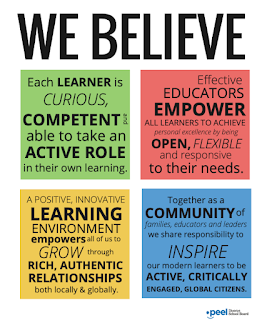

image from peelschools.org


Further Development of the Vision:

Developing Self Awareness Through MyBlueprint, a Digital Portfolio

image from bitmoji.com


Learner Considerations: Who's Lookin'?

image from clipart key.com
image from favpng.com
image from cliparts.zone


image from gograph.com


image from leaderinme.org

who is a part of a student's learning network? Their teachers, parents, families, and 

peers.  A child's learning network is vast and all their stakeholders would find value to 

see what they are learning and HOW they are learning.  Teachers that would be 

interested in pursuing digital portfolios within grade groups, the school, the district, 

and globally would also be potential audiences.  For me, I need to see an app or 

program, and have someone show me and vet it if I were to try it out.  Knowing that 

there is someone I can communicate, ask questions, show my progress and get feedback 

makes a program more desirable to use.  At school, I never would have tried Daily 5 or 

words their way, if I didn't know many of the staff were using it.  I had that safety net 

if I was trouble shooting.  Personally, just starting a blog was daunting.  I began with 

one blog format and had extreme difficulty.  I then started a new avenue, and if two 

colleagues from the program didn't reach out to me and help me step by step, I wouldn't 

have continued with this choice either. You don't become a wizard at things overnight.

Potential Audience for Artifact

There are many resources available from MyBlueprint's website:

https://myblueprint.ca/about on how to get started - supporting the teacher.  However, 

when planning a journal, typing a reflection or preparing materials to publish in their 

student portfolio, there needs to be some background knowledge and reasoning, lesson 

planning that should go on; a blended model approach.  

I plan on preparing some beginning lesson plans to support using the "About Me" section 

of My Blueprint.  I initially planned on teaching metacognitive skills as well, but with 

time constraints and access to technology, I bit off a bit more than I could chew.  I 

appreciate the Blended learning approach to the digital portfolio because I have more 

formative assessment opportunities to evaluate how their self-awareness skills have 

progressed.  as well, because students are also just learning how to navigate using a 

tech device and typing, as well as having very few minutes of the day, it may not be 

thoroughly capturing their reflections.  This coursework is for a librarianship diploma 

and it just seems right to be including possible literature to support digital learning.

Preparing My Artifact: Lesson Plans to Get Started 

on MyBluePrint

There are many links and tutorials for educators to get started on myblueprint from 

the company itself.  However, there isn't a HOW to actually teach each of the elements 

of reflection, journalling, and resources to make it meaningful, like templates for 

drafts and picture books (I'm gearing my lesson plans for primary).  I have been able to 

make progress through the "About Me" section of My Blueprint with my Grade 3s and 

they 100% enjoy it.  They are even beginning to notice what comes easy to them, like 

creating an avatar, persevering through technical difficulties, and what has been 

challenging like I want to say more, but I can't type fast enough.  As we learn together, 

I have been keeping mental notes of how I could revise the delivery of certain sections 

of my blueprint, how a book here, or a writing draft there could have strengthened the 

class' productivity.  This made me think of how I would have really appreciated more of 

a teacher's manual of how to get started, not the technical aspect, but the teaching 

aspect.

I plan to make introductory lesson plans by using pageshttps://www.apple.com/ca/pages/


                                           image from support.apple.com

I am continuing my professional development with apps and digital programs, and pages 

is one that I have yet to use.  I like how it is visual, you can record audio and pictures, 

and is editable for others.  Because the district uses apple products, it will be 

streamlined and teachers will not have to worry about downloading adobe, Vimeo 

extensions, etc.  I am really looking forward to creating a working document that can 

drum up discussion, collaboration, and utility.

My vision for the future continues to be that of one where my classroom or SLLC is a 

place of community, collaboration, and engaged learning.  I strongly feel by reflecting 

and becoming more explicitly aware of their learning process via digital portfolios 

alongside a blended model of traditional teaching approaches and technology will help 

facilitate 21st century skills like critical thinking, creativity, leadership, and digital 

literacy.  Time to start a'brewing!


image from bitmoji.com


Works cited

BluePrint, M. (n.d.). My Blueprint. Retrieved November 20, 2020, from https://myblueprint.ca/about

Board, P. (n.d.). Empowering Modern Learners. Retrieved November 20, 2020, from https://www.peelschools.org/aboutus/21stcentury/Pages/default.aspx

Eurich, T. (2020, November 01). What Self-Awareness Really Is (and How to Cultivate It). Retrieved November 19, 2020, from https://hbr.org/2018/01/what-self-awareness-really-is-and-how-to-cultivate-it

Pages - Apple (CA). (n.d.). Retrieved November 21, 2020, from https://www.apple.com/ca/pages/


Friday, October 23, 2020

LIBE 477 63A Supporting Teachers’ ICT Curriculum and Pedagogy: On-going Professional Development

Sharing is Caring

In TED Talks, The Way We Work series Robert Reffkin gives viewers suggestions to stay connected with their co-workers.  He claims that "technology has made it easier to communicate.  But it hasn't made it easier to connect with other human beings" (2020). How evident is this now?  I can only imagine being a part of a new school right now.  Making meaningful connections at present require more time, creativity, and effort amidst all the other challenges that face educators today; a special type of brew.


image by Bitmoji

The three that I really appreciated are:
👍 show gratitude - be thankful for your peers' abilities, skills, talents, and willingness to share them.
👍 share and inquire - share resources/ideas/your point of view and be open to receiving others'
👍 be honest - go beyond the "niceties" of small talk and really get to know the people you are working with.

At the moment, I am co-teaching the Seven Sacred Teachings (this is a full unit plan if anyone may be interested) with our school indigenous support worker.  Some of the ideas that Reffkin offers tie in with the teachings: 

image from southernnetwork.org


Just to use as an example, the grade 3 curriculum is focused entirely on indigenous studies.  I am quite aware that I am not an expert in the field, however, I do know there are many in the district that are trained to support my students' learning in this subject area.  Instructors from the district have come to the school to explicitly teach peace/sharing circles.  To promote awareness and understanding of indigenous cultures, the Aboriginal Program offers classroom presentations, for example in grade 3, Ms. Gabriel teaches students about Sto:lo tools past and present.

Image from Bitmoji.com

Who knows what hidden talents, skills, and professional development your colleagues have?  I worked with an intermediate teacher and I would like to think I was friendly enough with him, but I had no idea that he was opera trained!  He never volunteered for the Christmas concerts and just by chance our friendly conversations turned into this little treasure revealed.


How can we best respond to the needs of our staff, in their wide spectrum of abilities and experiences, with the most appropriate and useful professional development?
We need to know what the actual needs are of our staff: being a part of school based team meetings, school goal committees, action plans, and other groups within the school that focus on student needs and improvements will give us a more thorough understanding of what professional development would be appropriate and useful for fellow staff members.

In our district, we use Microsoft Teams, and the TL having a channel of his/her own would help teachers look back at any staff meeting presentations available for viewing later, instructions for using tech tools in the learning commons, link to book TL/llearning commons facility, etc.  Because it is a program that each teacher in the school has to use on a regular basis, it is easy access for peers.


Image from Bitmoji.com


How can we, as educators and TLs share what we've learned with our wider communities of practices?
As we all have experienced, in order for learners to engage, there has to be a "buy in".  I believe the same goes with adult learners.  Canvasing co-workers, be it personal drop-ins or an inquiry note in their mailbox,, noticing frequently checked out teacher resources and print material for the classroom, observing what teachers are attending for professional development days, or using online surveys to gather intel.  Most administrators will give their TLs time during staff meetings to up to date everyone on what is happening in the learning commons, so I feel that is a great start - something short, sweet, and enticing.  I have seen TLs use SWAY, Bitmoji Classroom, Prezi, and Keynote.  
image from sway.office.com
image from weareteachers.org
image from prezi.com


What tools and strategies are best implemented to meet the professional development of staff?

As the professional development representative at my school level, I have found that scheduling presenters to come into the school for Pro D days have been more meaningful and has created team-building opportunities.  BCTF offers quite an array of speakers on various topics.  We have had speakers come in for conflict resolution, self-regulation, mindfulness, and balance.  Understanding where our co-workers are coming from and taking common professional development has been quite nurturing.

Caskey and Carpenter's article on Building Teacher Collaboration provides an explicit organizational model that promotes teacher collaboration within a school.  The biggest take away has been that collaboration must be meaningful - teachers that are working together share the same vision for their students on their focused topic.  Educators are willing and voluntarily carve time out to work, professional develop, gather data, and discuss students' needs, then put it into practice.

imagefromamle.org


Image from bitmoji.com

As a TL, providing mini-workshops to familiarize teachers with programs within the learning commons and resources has created an on-going professional development for teachers and EAs within the school.  Our previous TL held a "Tech Tuesday" after school for anyone and for any topic regarding technology that wouldn't be appropriate for the district IT team to problem solve.

What about the stakeholders?  TLs should be making a regular appearance in PAC meetings; there is a beneficial reciprocal relationship in the rough here.  As well, making connections with the local public library and their programs could support the school learning commons.  For example, if the public library is using coding tools like this one here: Spheros at FVRL and Ozobots at FVRL perhaps co-teaching and collaborating with teachers in the school to use these could also create on-going professional development and lead to new technology discoveries.

Image from Bitmoji.com


Works Cited

Caskey, M. M., & Carpenter, J. (2014). Building Teacher Collaboration School-wide. Retrieved October 22, 2020, from https://www.amle.org/BrowsebyTopic/WhatsNew/WNDet/TabId/270/ArtMID/888/ArticleID/446/Building-Teacher-Collaboration-School-wide.aspx

Coalition, O. (Ed.). (2020). Teachings of the Seven Sacred/Seven Grandfathers. Retrieved October 20, 2020, from https://onlc.ca/wp-content/uploads/2014/06/7-Grandfathers-Student-Manual1.pdf

Reffkin, R. (2020). 5 ways to create stronger connections. Retrieved October 21, 2020, from https://www.ted.com/talks/robert_reffkin_5_ways_to_create_stronger_connections