World Book Digital Encyclopedia
 |
| www.sd35.bc.ca |
Background
 |
| Photograph taken in Langley, B.C. 2021 |
- getting to know the community to help with selecting appropriate materials to meet student and staff interests and cover curricular content, keeping equity, diversity, and inclusion in mind
- foster a love for reading by promoting the collection within-house and sources within the district, advertising local events, connecting with the neighbourhood community, building a relationship with the nearest public library's librarians
- support reading programs
- encourage collaboration
- creating policies and procedures for selection, weeding, circulation, maintenance, inventory
- find fundraising opportunities to build makerspaces, ADST materials, and LC-related equipment, as well as print materials
- being knowledgeable about the school collection
- evaluation of the collection and student and staff feedback to guide future selections
- knowing and providing digital and physical resources that are accessible and relevant to the school's needs
Evaluating resources is extremely important as the building of the physical collection continues. According to Riedling, reference sources can be divided into two main classes:
1) compilations that furnish information directly (encyclopedias, dictionaries, almanacs, handbooks, yearbooks, biographical sources, directories, atlases)
2) compilations that refer to other sources containing information, merely indicating places in which information can be found (bibliographies and indexes).
(2013, 18)
Physical resources are limited in DGRE's K-5 collection:
 Figure 1 Destiny Catalog  |
Figure 2 Destiny Catalog World Book Digital EncyclopediaStaff is able to view collections created in Destiny or the district's digital resources page. The WORLD BOOK digital resources is provided to staff and students through Focused Education Resources. With a universal username and password, SD35 staff and students can access the research platform and its vetted databases at home and at school. The district funds this, so it saves individual schools time and money. "In all formats, encyclopedias remain essential reference sources for school libraries" (Riedling, p.70, 2019). In K-5, there is a trend of educators and districts moving away from universal texts covering one subject area. An example of a classroom resource covering one subject area is Math Focus 3, last published in 2009. Most educators are unable to fully use the program and rather supplement, adapt, and modify to differentiate for students in order to meet them where they are at.  Teachers individually create their own cross-curricular programs connecting to their strengths and passions. Encyclopedias will not be the sole resource utilized in a project, but act as "...springboards to additional information", as a ready reference (Rielding, 2019, 17). Below is Riedling's Evaluation of Encyclopedias and the Langley School District's Evaluation of Resources:  Figure 3 Riedling's Evaluation of Encyclopedias   In combination with Langley's evaluation form and Riedling's evaluation of encyclopedias and Langley's evaluation criteria for learning resources, below is a rubric created for non-print encyclopedias: 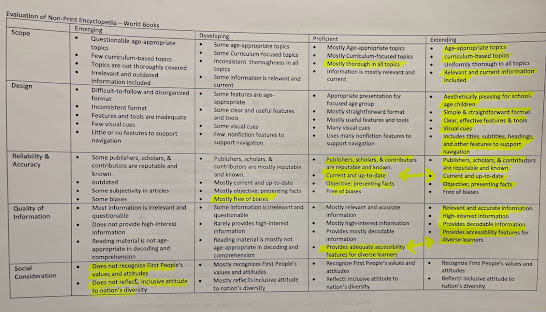 Figure 5 Evaluation of Non-Print Encyclopedias World Book Encyclopedias in highlights World Book Early LearningWorld Book Early Learning is geared to younger learners (K-2), the colourful, child-friendly presentation allows students to explore rather than pose a specific question that requires deeper research. This aligns with the B.C. Curriculum in a number of ways. Below are a few Big Ideas from K-3 that World Book Early Learning incorporates: Career Education Big Ideas
ADST
Language Arts
Text can be overwhelming for early readers. Students can hover over pictures and words for verbal instruction. The voice is set as a child's voice. World Books Early Learning is fully functional and can be used on cell phones, tablets, laptops, and computers. Subject matter like animal homes, dinosaurs, senses, and community are popular themes, which are included in videos and stories. Popular nursery rhymes are sung and students can follow along. Games can be played individually or collaboratively.  Teachers are able to click on "For grownups" and search for material by curriculum, grade, and topic. They provide lesson plans, as well as a guided reading program to support language competencies. This is not to say that this platform was made to cover the entire curriculum. "Encyclopedias should not be considered sole sources of information, although they do assist in directing and strengthening a student's subsequent work" (Riedling, 2019, p.71). If a teacher is working on counting to 20 or discussing the seasons, there are many supplementary activities through stories, songs, and games throughout the encyclopedia. It is a very robust resource; with tutorial videos, training guides, and extensive tech support. World Book Kids World Book Kids is designed for independent readers. The design is similar to Early Learning and the choices of activities are more diverse, with a search function as the centre focus of the home page.  Extra features to World Book Kids:
World Book Kids addresses diverse languages, but doesn't address Indigenous perspectives, even with the advanced search option. Unless students are specifically researching Tlingit or residential schools, the Indigenous perspective is not interwoven within the games, activities, and articles. Overall, World Book Kids allows students to be more independent and research-oriented. Teachers can use tutorials to help students plan their inquiry. World Book Discover World Book Discover has the same articles found in World Book Kids. With its title Discover, the material is organized by topic and with a more inquiry-style format. Similar to platforms like Netflix or Apple TV, World Book Discover organizes information by Featured and Popular. The games are more advanced (multiplication, roman mythology, know your music notes) and students are able to create a student login that will save all their articles for research, and keep their high scores for games. Information, games, and activities would not suit many intermediate students in elementary school, but I can see them being used in late middle school or early high school. There were a lot of American-focused activities. This might be more of an explorative platform in term 3 with Grade 5s as they think forward to middle school and the resources that are available to them. Potential Physical Resource: National Geographic Kids World Atlas 6th Edition  Published in 2021, the National Geographic Kids World Atlas Sixth Edition is one of the most current atlases available to K-7 students. In the B.C. Curriculum, mapping is part of the key skills related to the Social Studies' core competencies. The resource helps break down how to use an atlas in its introductory pages. Many visual features help with decoding and scanning for important information. BIGGER font draws the eye to the general information, and various font sizes, subheadings, colour, and spacing of visuals like diagrams, photographs, and tables make the pages more engaging rather than overwhelming. Images really highlight the diversity in flora, fauna, and culture. Maps vary from topographical, thematic, and general reference. Back of the Book information like the glossary, geo facts and figures, and the index are thorough, coloured, and varied font help with navigation.        "A five-year-old atlas is considered historical" (Riedling, 2013, 80). Currency is vital as old geographic sources become "obselete information to be considered only for historical purposes" (81). When searching all elementary schools (45) in Destiny, finding more than 2 copies of one specific encyclopedia or atlas was rare. Finding an atlas with a publishing date 2019 or later was extremely rare. When searching for an appropriate resource for the elementary LC, looking for a resource that was less costly due to the need to replace it was frequent.  Figure 6 Riedling's Evaluation of Geographic Sources Riedling already recommends National Geographic Atlas for current world and thematic world atlases (2013, 82, 83). After researching different prices from various vendors, ULS provides this resource at a reasonable price of $24.79 CAD before taxes. Many quality hardcover picture books cost near or more than that price. Below is my highlight evaluation of the resource. It is not suitable for K-2 typical reading levels, but because mapping and resource competencies occur in Grades 3+, reading decodability is within late primary and intermediate reading levels. Teachers may use the atlas as part of beginning discussions of mapping, provinces, and countries before delving into more narrow topic-focused resources.  Evaluation of Atlas Final ThoughtsAfter discussions with elementary TLs in the district, the district librarian, and browsing other school collections in Destiny, many K-5 schools steer towards digital resources rather than physical ones for a variety of reasons. "Many libraries find that their reference collection is shrinking rapidly; however, a good ready-reference collection continues to be a vital component of good service" (Crew, 2023, p. 37). Budgets are limited and accommodating varying reading levels and subject areas in all grades is a challenge. Teachers prefer digital resources due to easy access for students. Having reliable and current resources is as important as having electronic resources. "One of the most important tasks of a school librarian is to help students and teachers find the best materials available-in all formats-to support teaching and learning" (Riedling, 2013, 18). Below are photographs of Donna Gabriel Robins Elementary's SLLC in September 2021, year one, and February 2023, year two. Physical resources like encyclopedias and atlases are vital like picture books and graphic novels as it builds fostering literacy and community. |


References
Evaluating learning resources. Instructional Services | #Think35. (n.d.). Retrieved February 1, 2023, from https://instructionalservices.sd35.bc.ca/curriculum/locally-approved-resources/
Focused Education Resources. (2021, July 15). BC Digital Classroom. Focused Education. Retrieved February 1, 2023, from https://focusedresources.ca/en/bc-digital-classroom
Geographic, N. (2021). National Geographic Kids World Atlas 6th edition (6th ed.). National Geographic Kids.
Leominster Public Library. (2020, July 17). World book encyclopedia for kids tutorial. YouTube. Retrieved from https://youtu.be/nW0uk12lwUQ
Math focus (grade 3). Nelson. (n.d.). Retrieved February 2, 2023, from https://school.nelson.com/math-focus-grade-3/


